简体中文
简体中文

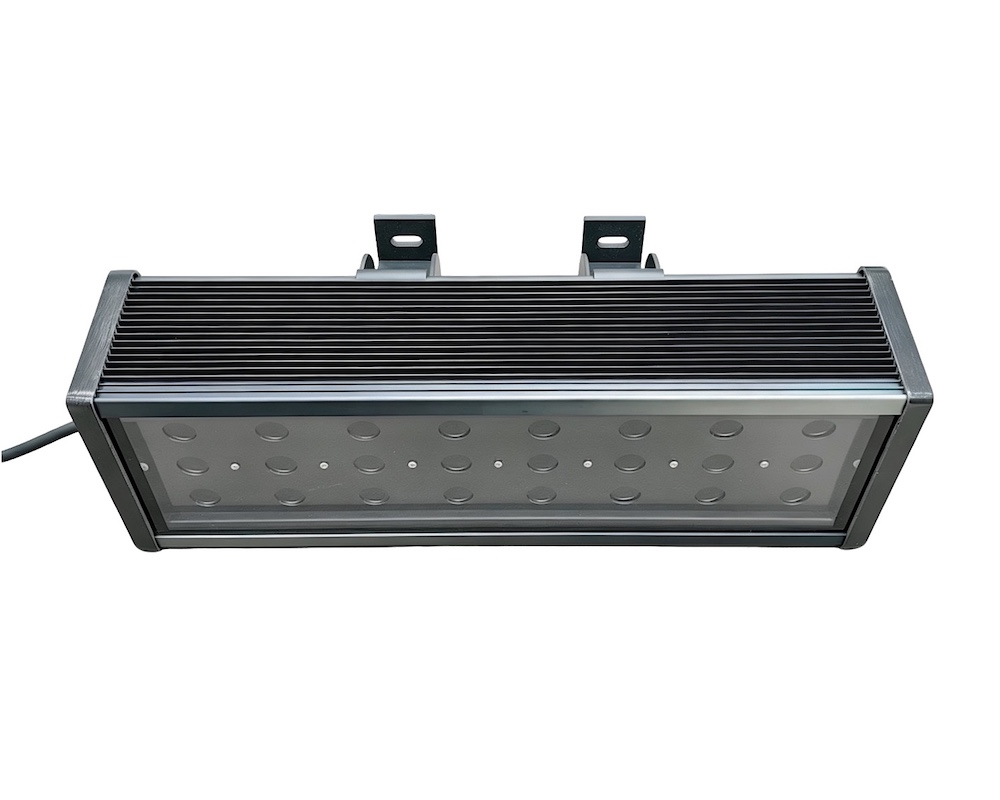
In a study published in Horticulture Research, researchers from the Chinese Academy of Agricultural Sciences developed an efficient genetic transformation system for cucurbit crops (melon, squash, and cucumber) using an "optimal infiltration intensity" strategy. To identify transgenic plants expressing GFP, the team employed a LUYOR-3415RG fluorescent protein excitation lamp for fluorescence observation.
Abstract
Fruits and vegetables in the Cucurbitaceae family contribute greatly to the human diet, for example, cucumber, melon, watermelon and squash. The widespread use of genome editing technologies has greatly accelerated the functional characterization of genes as well as crop improvement. However, most economically important cucurbit plants, including melon and squash, remain recalcitrant to standard Agrobacterium tumefaciens-mediated transformation, which limits the effective use of genome editing technology. In this study, we describe the “optimal infiltration intensity” strategy to establish an efficient genetic transformation system for melon and squash. We harnessed the power of this method to target homologs of the ERECTA family of receptor kinase genes and created alleles resulting in a compact plant architecture with shorter internodes in melon, squash and cucumber. The optimized transformation method presented here allows stable CRISPR/Cas9-mediated mutagenesis and will lay a solid foundation for functional gene manipulation in cucurbit crops.
Detection of GFP Fluorescence with LUYOR-3415RG
To screen the GFP-positive plants, explants regenerated for one month were examined using a Leica MZ10 F stereomicroscope (Leica Microsystems, Germany) at the tissue culture stage. The GFP fluorescence of the plants was observed upon excitation with a LUYOR-3415RG fluorescent protein excitation lamp (Luyor Instrument, Shanghai) in the greenhouse. The explants treated with different infection intensities were sectioned by hand along the transverse and longitudinal directions on ice, and GFP fluorescence of portions with vascular tissue was observed immediately under the stereomicroscope.
Figure 2. (d) A regenerated transgenic T0 plant of melon was transferred to the soil. The GFP-fluorescent apical meristem (e) and seeds (f and g) of the transgenic melon T0 plant. The transgenic T1 plant (h) and WT (i) of melon under the GFP channel of the LUYOR-3415RG fluorescent protein excitation lamp. Tissues appear green because of GFP expression and red because of chlorophyll autofluorescence.
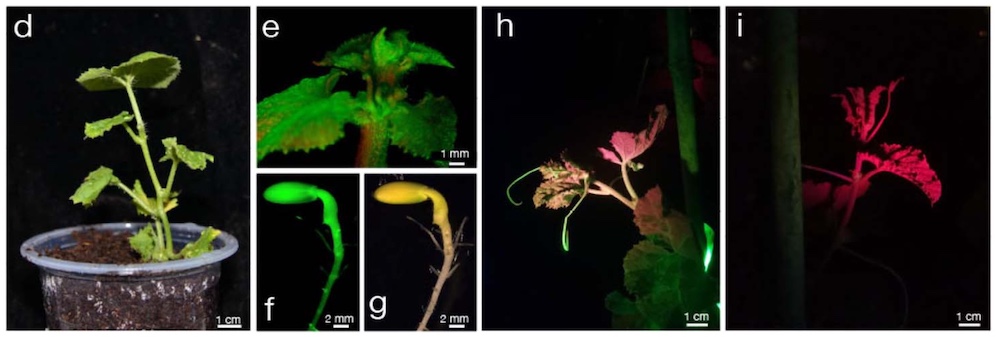
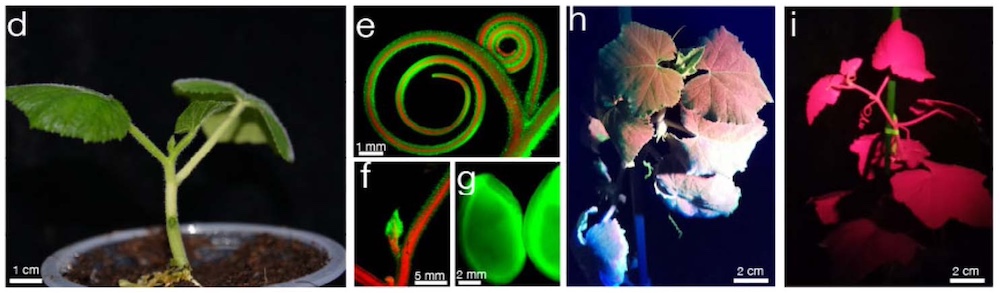
Figure 3. (d) A regenerated transgenic T0 plant of squash after one week of transfer to soil. The GFP-fluorescent tendril (e), apical meristem (f), and seeds (g) of a transgenic squash T0 plant. A transgenic T1 plant (h) and WT plant (i) of squash under the GFP channel of the LUYOR-3415RG fluorescent protein excitation lamp.
Reference
Xin, T., Wang, S., Tian, H., Ma, Y., Chen, C., Li, X., Wang, H., Li, H., Huang, S., Zhang, M., & Yang, X. Optimal infiltration intensity strategy enables stable CRISPR/Cas9-mediated genome editing in melon and squash. Hortic. Res. 9, uhab086 (2022).