简体中文
简体中文

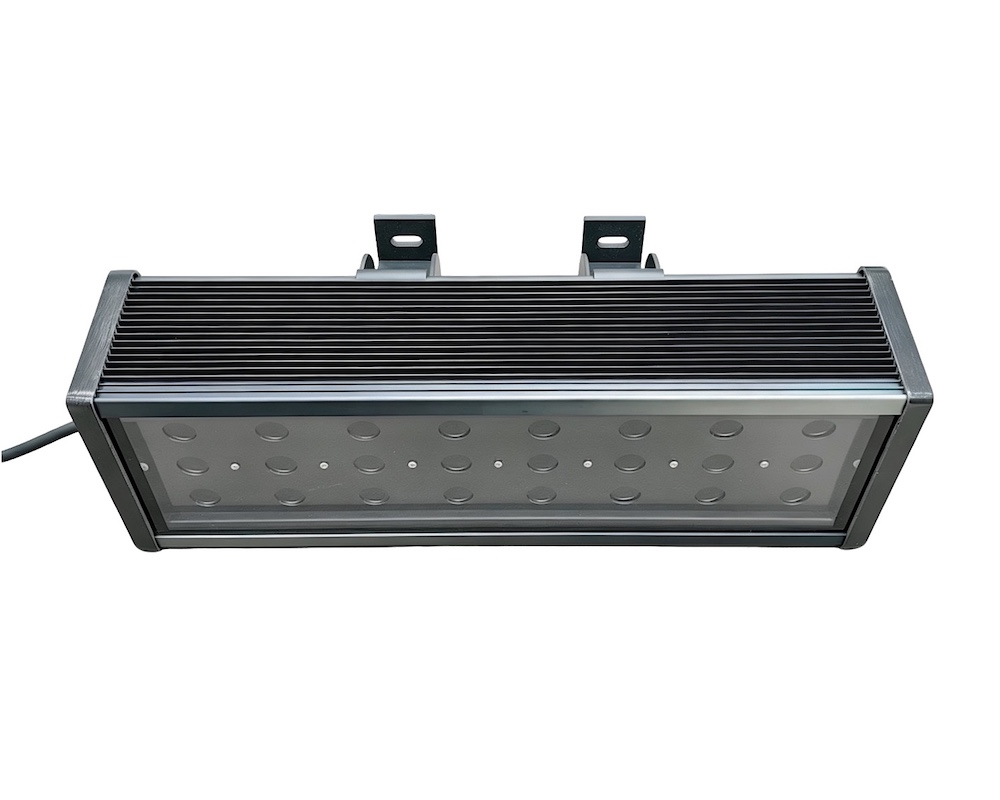
In a Biology study, researchers developed a rapid, efficient, and visual FHR-SCN pathosystem to study gene functions in the soybean–soybean cyst nematode interaction and used fluorescent protein excitation lamp LUYOR-3415RG to visualize GFP fluorescence in Agrobacterium rhizogenes-mediated soybean hairy roots.
Summary
The soybean cyst nematode is a pathogen that is parasitic on soybean roots and causes high yield losses. To control it, it is necessary to study resistance genes and their mechanisms. The existing means take half a year but our new method can accelerate the process. We built new tools and integrated the advantages of current technologies to develop an FHR-SCN system. This method shortens the experimental period from half a year to six weeks. Researchers can differentiate between the roots that are transgenic and those that are not with a blue light flashlight and filter. Using this method, we verified a gene that could provide an additional contribution to resistance against the nematode. In addition, we used a transgenic soybean to verify and further indicate that this resistance was caused by an increase of jasmonic acid. The FHR-SCN pathosystem will accelerate the study of the soybean resistant gene.
Abstract
Background: The yield of soybean is limited by the soybean cyst nematode (SCN, Heterodera glycines). Soybean transformation plays a key role in gene function research but the stable genetic transformation of soybean usually takes half a year. Methods: Here, we constructed a vector, pNI-GmUbi, in an Agrobacterium rhizogenes-mediated soybean hypocotyl transformation to induce fluorescent hairy roots (FHRs). Results: We describe the operation of FHR-SCN, a fast, efficient and visual operation pathosystem to study the gene functions in the soybean-SCN interaction.
With this method, FHRs were detected after 25 days in 4 cultivars (Williams 82, Zhonghuang 13, Huipizhiheidou and Peking) and at least 66.67% of the composite plants could be used to inoculate SCNs. The demographics of the SCN could be started 12 days post-SCN inoculation. Further, GmHS1pro-1 was overexpressed in the FHRs and GmHS1pro-1 provided an additional resistance in Williams 82. In addition, we found that jasmonic acid and JA-Ile increased in the transgenic soybean, implying that the resistance was mainly caused by affecting the content of JA and JA-Ile. Conclusions: In this study, we established a pathosystem, FHR-SCN, to verify the functional genes in soybeans and the SCN interaction. We also verified that GmHS1pro-1 provides additional resistance in both FHRs and transgenic soybeans, and the resistance may be caused by an increase in JA and JA-Ile contents.
Screening GFP In Hairy Roots Using LUYOR-3415RG
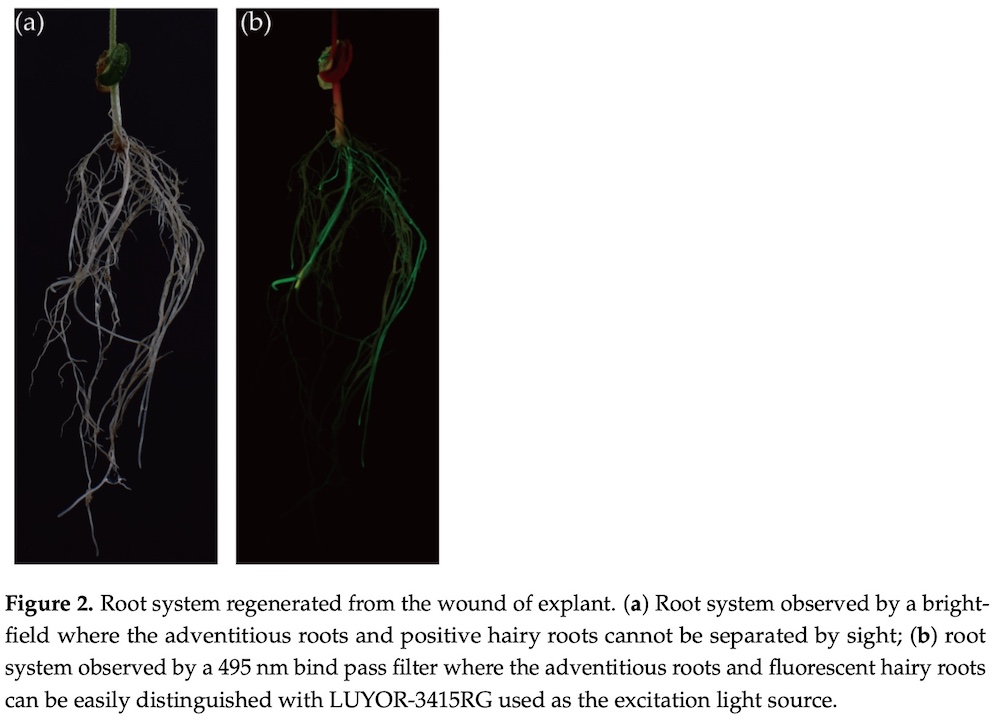
The fluorescence in the positive hairy roots was excited by a LUYOR-3415RG fluorescent protein excitation lamp. The roots emitted a green fluorescence that could be observed through a band pass filter (495 nm, Luyor, Shanghai, China). The composite soybean plants were washed after 20 days of growth for the fluorescence detection. The number of regenerated roots and fluorescent hairy roots (FHRs) of 30 composite plants in each soybean cultivar were counted. The results were plotted and the significant differences were analyzed using a one-way ANOVA.
Photo below: GFP fluorescence in soybean hairy roots under fluorescent protein excitation lamp LUYOR-3415RG
Reference
Yang, R., Li, S., Yang, X., Zhu, X., Fan, H., Xuan, Y., Chen, L., Liu, X., Wang, Y., & Duan, Y. Fluorescent soybean hairy root construction and its application in the soybean–nematode interaction: An investigation. Biology 10, 1353 (2021).