简体中文
简体中文

In a Nature Plants study (Ren et al., 2025), the researchers used the LUYOR-3415RG Dual Fluorescent Protein Excitation Lamp for rapid, non-destructive fluorescence screening of transgenic soybean hairy roots to investigate the BRUTUS-NSP1 nodulation mechanism.
Abstract
Legumes form root nodules with symbiotic nitrogen-fixing rhizobacteria, which require ample iron to ensure symbiosis establishment and efficient nitrogen fixation. The functions and mechanisms of iron in nitrogen-fixing nodules are well established. However, the role of iron and the mechanisms by which legumes sense iron and incorporate this cue into nodulation signalling pathways remain unclear. Here we show that iron is a key driver of nodulation because symbiotic nodules cannot form without iron, even under conditions of sufficient light and low nitrogen. We further identify an iron optimum for soybean nodulation and the iron sensor BRUTUS A (BTSa) which acts as a hub for integrating iron and nodulation cues. BTSa is induced by rhizobia, binds to and is stabilized by iron. In turn, BTSa stabilizes and enhances the transcriptional activation activity of pro-nodulation transcription factor NSP1a by monoubiquitination from its RING domain and consequently activates nodulation signalling. Monoubiquitination of NSP1 by BTS is conserved in legumes to trigger nodulation under iron sufficiency. Thus, iron status is an essential cue to trigger nodulation and BTSa integrates cues from rhizobial infection and iron status to orchestrate host responses towards establishing symbiotic nitrogen fixation.
Screening Transgenic Hairy Roots Using LUYOR-3415RG Fluorescent Protein Excitation Lamp
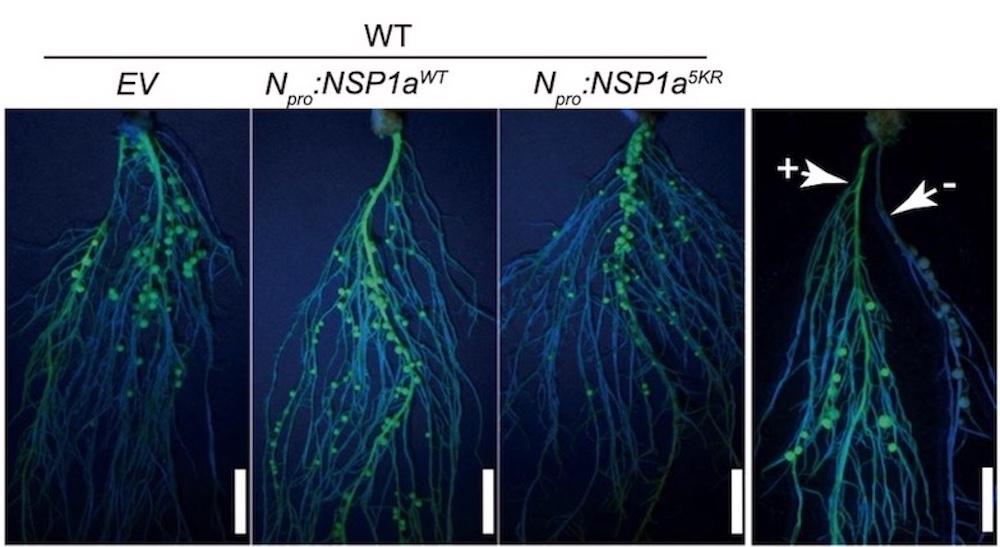
Hairy-root transformation with Agrobacterium rhizogenes K599 was carried out as described. In brief, 3-day-old seedings were used for transformation. Transgenic composite plants were transferred to vermiculite in a growth chamber. For iron treatments, 7-day-old composite plants were transferred to vermiculite moistened with BD–LN nutrient solution for 3 d, and then inoculated with B. diazoefficiens USDA110, and hairy-root samples were collected for further analysis. Transgenic hairy roots were screened using a portable Dual Fluorescent Protein Excitation Lamp LUYOR-3415RG to visualize GFP fluorescence.
Figure below: The constructs contain a 35Spro:GFP expression cassette to visualize transgenic roots.
+ represents the transgenic roots with GFP fluorescence
– represents the non-transgenic roots without GFP fluorescence
Dual Fluorescent Protein Excitation Lamp LUYOR-3415
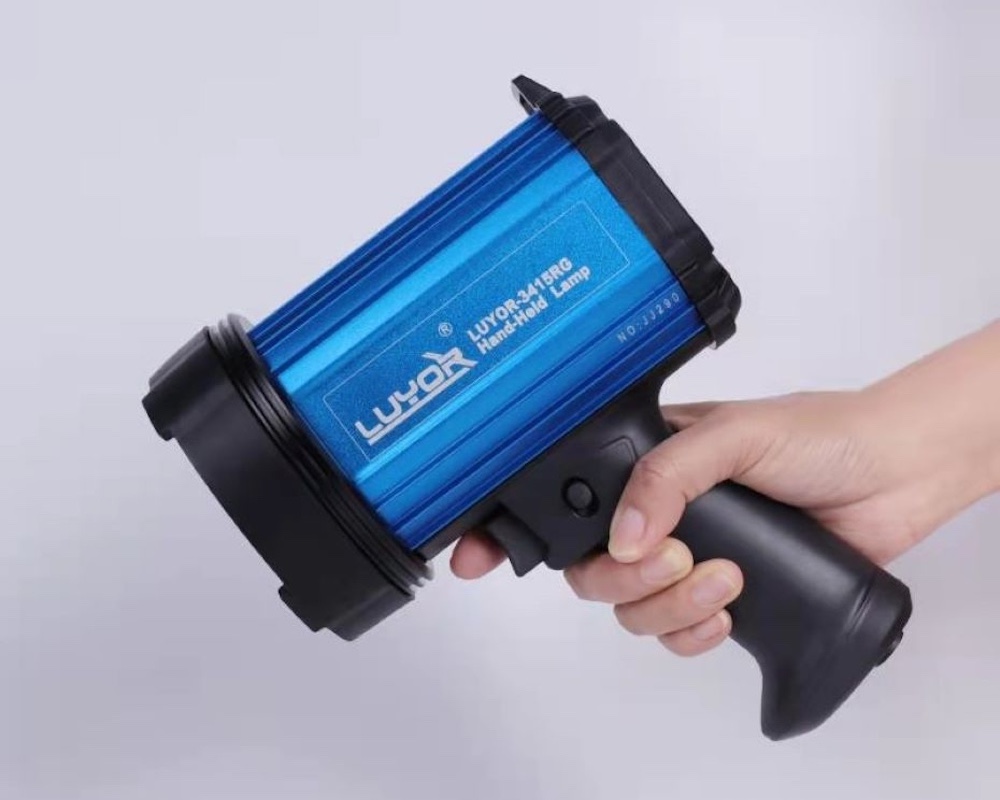
The LUYOR-3415 Dual Fluorescent Protein Excitation Lamp is a portable, powerful excitation light source that includes two different, switch-selectable high-intensity LEDs for excitation of fluorescent proteins or other fluorophores, and came with matching barrier filter glasses. Visualize fluorescence in leaves, roots, seeds, live animals, cells, microorganisms, ... the LUYOR-3415 provides what you need!
Photo below: Dual Fluorescent Protein Excitation Lamp LUYOR-3415RG, designed for GFP and RFP detection
Reference
Ren, Z., Zhang, L., Li, H. et al. The BRUTUS iron sensor and E3 ligase facilitates soybean root nodulation by monoubiquitination of NSP1. Nat. Plants 11, 595–611 (2025).